
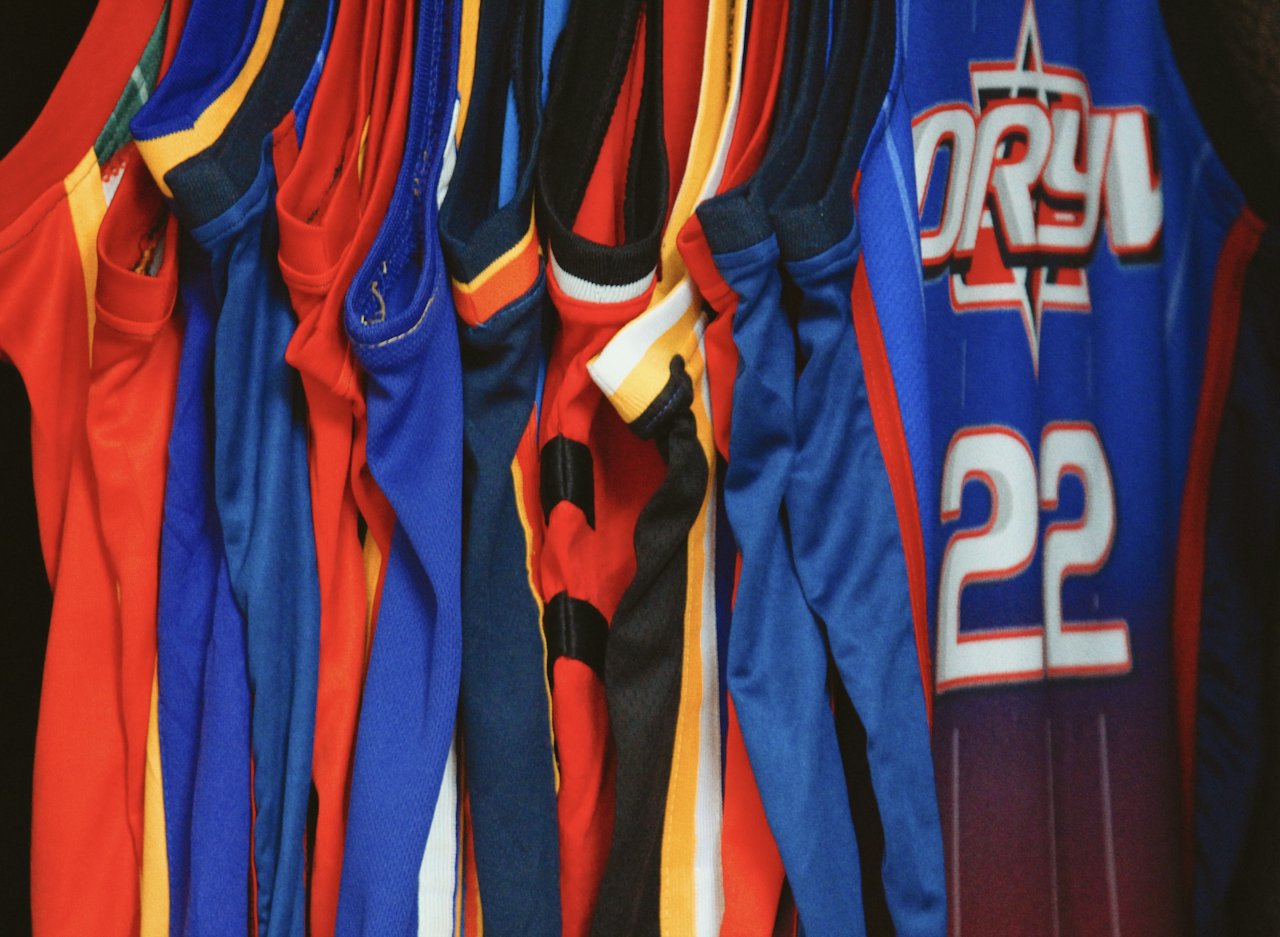
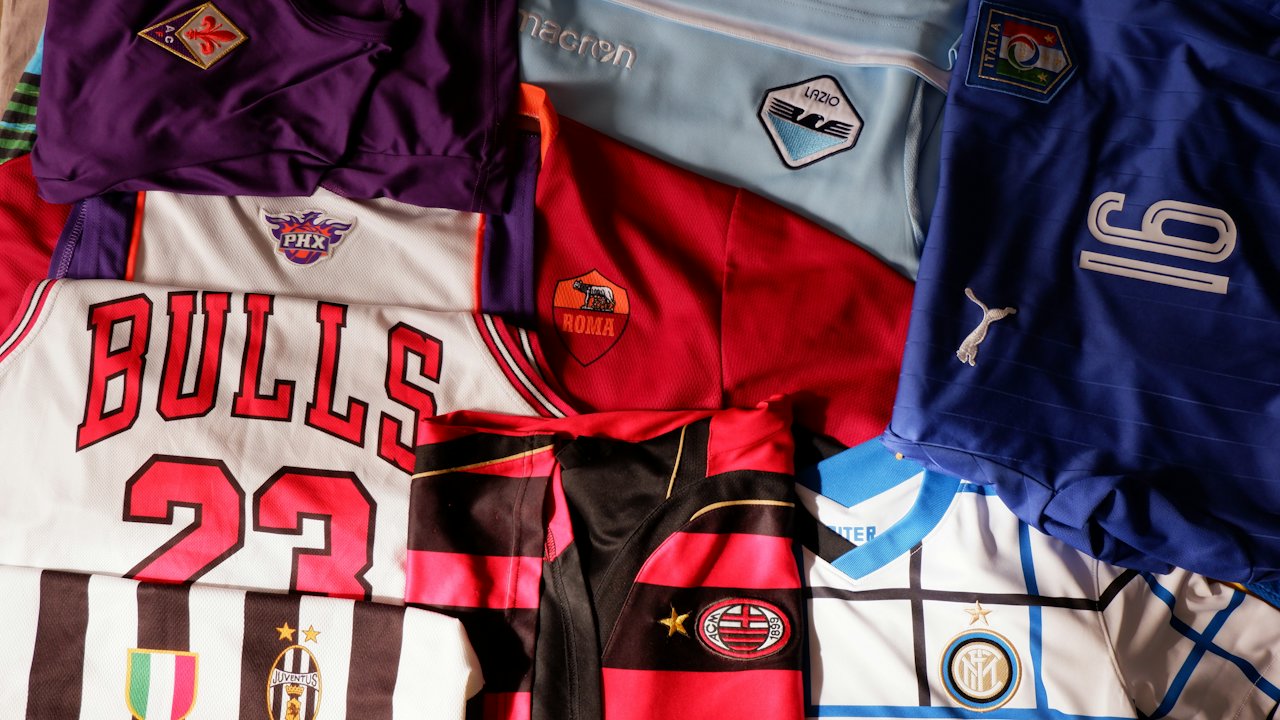
Team kits are one of the biggest markets for heat transfer vinyl. Every club, school and company league needs names and numbers – often on short notice and in small quantities that make screen printing uneconomical. But sportswear is also one of the most demanding substrates: synthetic, stretchy, often sublimated and washed after every match. Here is how to get it right.
Know your fabric
Most modern jerseys are made of 100% polyester or polyester/elastane blends, frequently with moisture-wicking finishes. Some are knitted with an open mesh structure. Each of these properties affects HTV application:
- Polyester is heat sensitive – it can scorch or show shiny press marks above approx. 150 °C.
- Elastane (Spandex/Lycra) requires a stretchable film that recovers with the fabric.
- Water-repellent or silicone finishes can prevent adhesion – always run a test.
- Mesh offers less surface for the adhesive; firm pressure and a slightly longer dwell help.
The dye migration challenge
Dye migration (also called "bleeding") happens when disperse dyes in coloured polyester turn into gas under heat and move into the vinyl. A white number on a red jersey slowly turns pink – sometimes immediately, sometimes days later.
How to prevent it
- Lower the temperature: press polyester at the lowest temperature that still bonds reliably – usually 130–140 °C for PVC films.
- Shorten the dwell time and use a cover sheet.
- Choose low-temperature or blocker films for sublimated and dark red, burgundy or royal jerseys.
- Test and wait: press a test number on an inside seam or spare jersey and check it after 24–48 hours.
Choosing the right film
| Use | Recommended VENYL film | Why |
|---|---|---|
| Numbers & names on cotton/poly | NS Non-Sticky | Fast hot peel, bold letters |
| Detailed club logos | ST Sticky | Holds small parts, precise layering |
| Stretch & compression wear | Printable PU / PU series | Thin, soft, high elasticity |
| Premium 3D numbers | HD High Density | Embossed pro look |
| Night visibility (running, cycling) | RF Reflective | Glass bead retro-reflection |
| Full-colour sponsor logos | DTF film | Photo-quality, stretchable |
Standard sizes for names and numbers
Leagues and federations often specify sizes. When no rules apply, these values work well:
- Back numbers: 20–25 cm high for adults, 15–20 cm for youth
- Front/chest numbers: 10 cm
- Shorts numbers: 8–10 cm
- Player names: 6–7.5 cm cap height, placed 5–8 cm below the collar
Keep a set of positioning templates for XS–XXL so every jersey in a team looks identical.
Reflective details for runners and cyclists
Adding reflective elements to training apparel is a great upsell. A small reflective logo on the back, sleeve stripes or a reflective name makes athletes visible in headlights. VENYL RF applies at only 140 °C, which also suits heat-sensitive technical fabrics.
Production workflow for team orders
- Collect a roster (name, number, size) in a spreadsheet.
- Generate all names and numbers in one file and nest them to save vinyl.
- Cut, weed and sort transfers into labelled bags per player.
- Pre-press each jersey briefly (2–3 s at low temperature for polyester).
- Press numbers first, then names, using templates for alignment.
- Quality-check each jersey against the roster before packing.
If you prefer to skip cutting and weeding altogether, our cut & weeded transfer service delivers roster-sorted, ready-to-press sets.
Aftercare for sports kits
Sports kits are washed frequently and often at high temperatures. Advise teams to wash inside-out at 30–40 °C, avoid fabric softener (which reduces both HTV adhesion and moisture-wicking performance) and not to tumble dry at high heat. Detailed recommendations are in our wash care guide.
Choosing fonts for numbers and names
Readability from a distance is the key requirement. Block and collegiate fonts with generous stroke widths (at least 15% of the character height for numbers) remain clear from the stands and on camera. Avoid very condensed fonts for names on small sizes, and add 1–2 mm letter spacing so letters do not merge when the fabric stretches. For two-colour numbers (fill + outline), design the outline at least 3–4 mm wide so it can be weeded and pressed reliably.
Layered numbers without the bulk
Two-colour numbers are popular but can feel heavy on lightweight jerseys. Instead of stacking the full fill on top of the full outline, cut the outline layer with a knock-out (the inner area removed) and only overlap 1–2 mm. The result looks identical from the outside, but the transfer is lighter, more breathable and more flexible.
Pressing on mesh and technical fabrics
- Insert a heat-resistant pad or cardboard inside the jersey to prevent the adhesive from penetrating to the back side.
- Use a firm, even pressure; mesh needs good contact to anchor the adhesive.
- Choose a cover sheet with a matte texture to avoid shiny marks on the polyester.
- Let the garment cool on a flat surface before stacking – warm adhesive can stick to the next jersey.
Quality control checklist for team orders
- Compare every jersey against the roster: name spelling, number, size.
- Check alignment with a ruler: names centred, numbers level.
- Try a gentle scratch test on the edges after cooling.
- Check for dye migration after 24 hours on high-risk colours.
- Fold jerseys with a sheet of paper over the transfers for the first days.
Pricing team work profitably
Team orders are often price-sensitive, but they bring volume and repeat business every season. Calculate material per jersey (typically 0.05–0.12 m of HTV for a number and name), labour for cutting, weeding and pressing, and a fixed set-up cost per order. Offering upgrades such as sleeve logos, reflective details or premium high-density numbers increases the average order value without much extra work.
A season-proof kit is the result of three things: the right film for the fabric, a tested temperature, and clear care instructions for the team manager.